There’s an organization called “Stratford the World”, which connects people from the various cities and towns named Stratford in the UK, New Zealand, Australia, the US, and Canada. Each year one of the Stratfords is selected as the host, and people from the other Stratfords are invited to visit, where they’re looked after by the locals. Greg’s brother Colin and his wife Elizabeth used to live in Stratford, Connecticut, and when it was that Stratford’s turn to host, Bev and Stew from New Zealand stayed with them.
Part-way thorough our time in Australia, Elizabeth offered to connect us with Bev and Stew. When she did, they immediately offered to have us stay at their home, and to show us around their part of the world. Which is how we came to visit the small town of Stratford, in New Zealand’s Taranaki region.
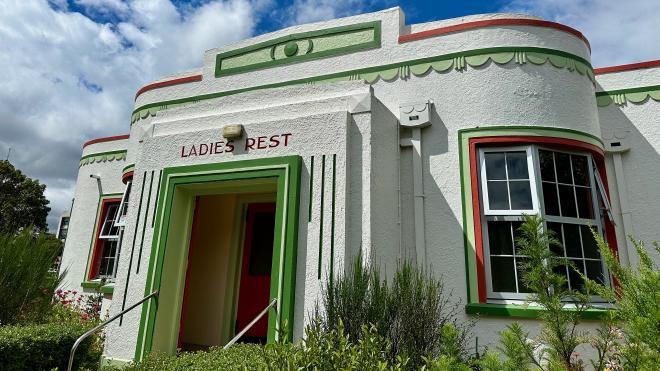
We had a lunch stop and change of bus in Palmerston North. Continuing the Art Deco theme from Napier, this is the women’s toilet at the i-Site where the bus stopped. Greg bought a couple of savoury pies from a nearby bakery, which we enjoyed on a bench in the sunshine.
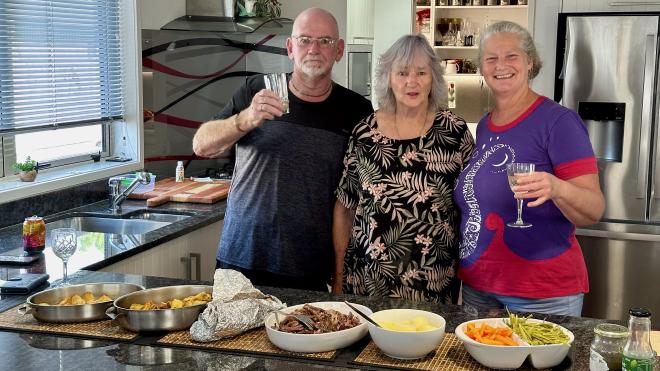
Our bus got in to Stratford about an hour late, making for an eight and a half hour travel day. Bev and Stew were at the stop to pick us up, and took us back to their lovely home where Bev had a delicious meal prepared. We took this picture to send to Colin and Elizabeth, so they could be properly jealous.
The biggest natural attraction around Stratford is Mount Taranaki, a striking volcanic cinder cone that rises out of gently rolling farmland. How you experience the mountain depends on the weather, since the peak is often shrouded in cloud – as it was on our first morning.
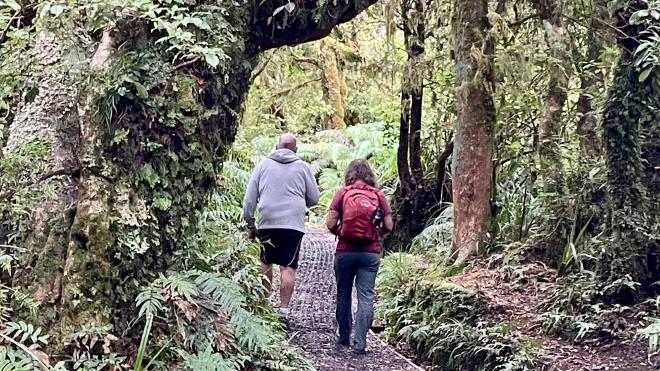
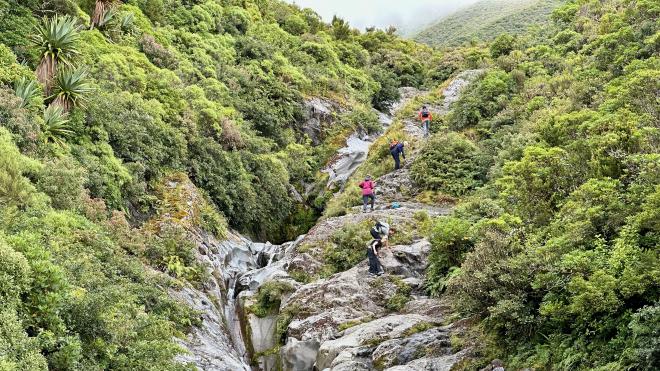
We headed into Egmont National Park, which surrounds the mountain, to visit some sights on its lower slopes. This is the Wilkies Pools Loop Track from the Dawson Falls Visitor Centre.
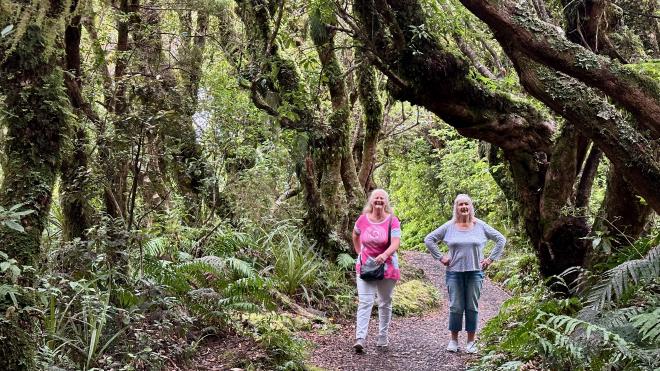
As you can see, the lower slopes of Mount Taranaki are dense rain forest; this part is called the Goblin Forest because of the moss and twisted trees.
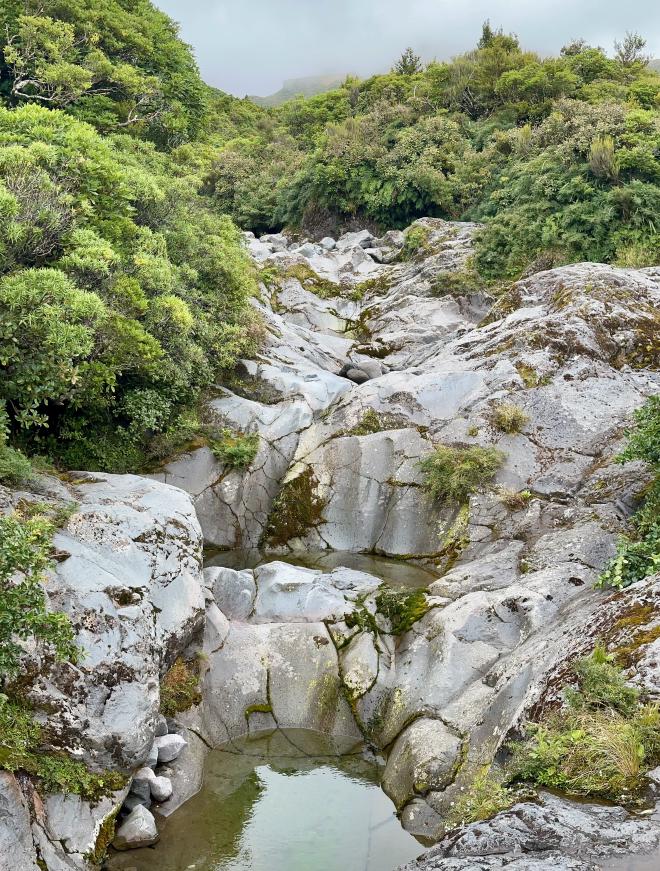
Here is the view looking up the watercourse that formed the pools…
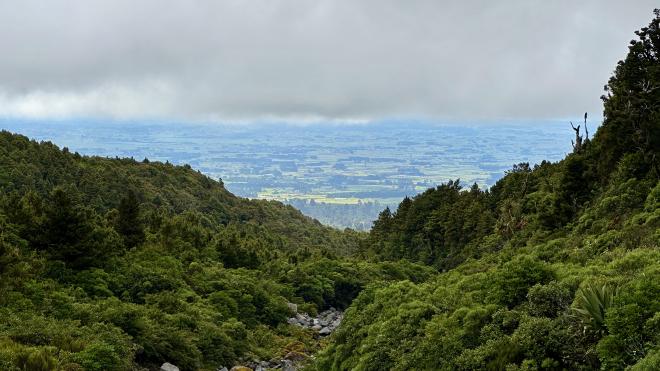
… and the opposite view, looking down the lower slopes of the mountain and eastwards over the surrounding plains.
There was only a trickle of water coming down the pools during our visit. After a heavy rainfall the flow can be quite spectacular.
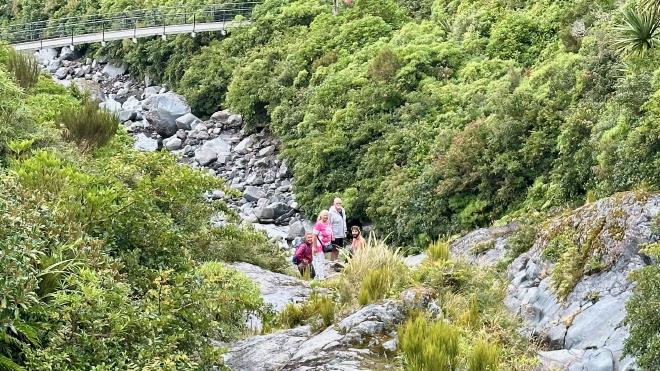
The man Karen and Stew are talking to just got out of one of the pools, where he’d been chilling (literally).
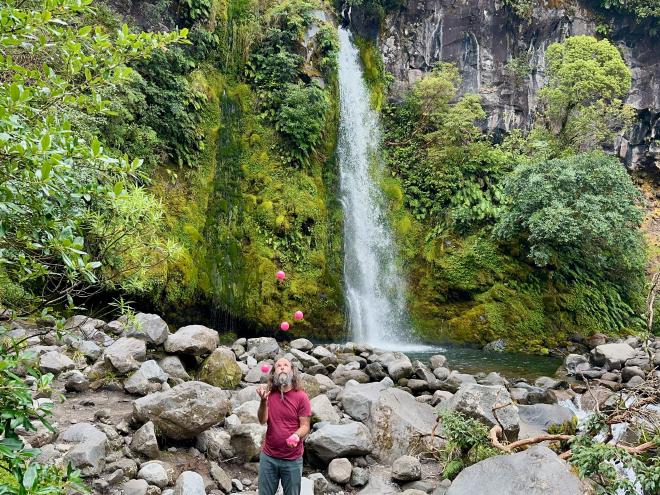
After leaving the pools, we drove downhill a short distance then walked out to Dawson Falls, where Greg felt compelled to add his cascade to the waterfall…
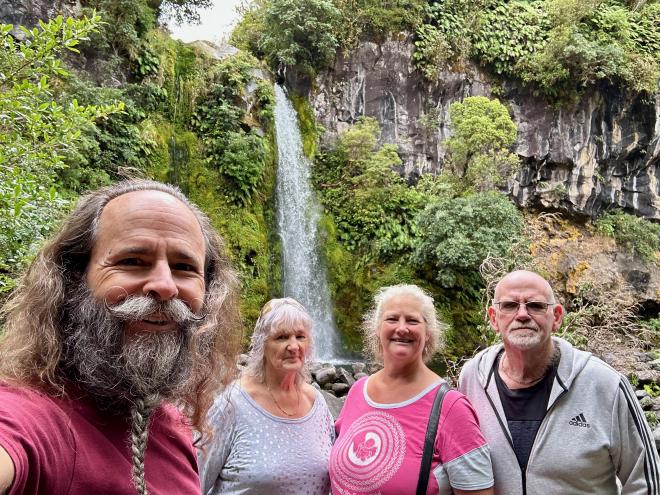
… and we got a group selfie. Bev is not big on pictures, but put up with us good-naturedly.
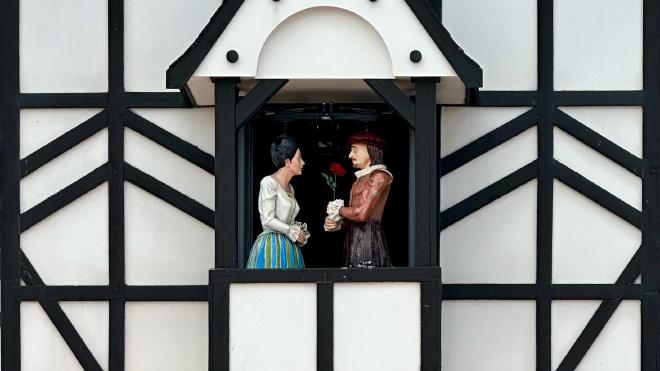
From there it was back to Bev and Stew’s for a bit of lunch, and then a brief venture into town for Karen to find a souvenir magnet at the i-Site. We timed the trip to catch the 1 pm performance of Stratford’s Glockenspiel (“playing clock”) clock tower. The show is a five-minute audio extract of scenes from Shakespeare’s Romeo and Juliet, during which figures of the couple appear from behind various doors in the tower.
Fortunately, the Glockenspiel only includes the happy bits from the beginning of the play, not the suicides at the end. They appear to have aged Juliet and Romeo up a bit from the young teenagers Shakespeare described.
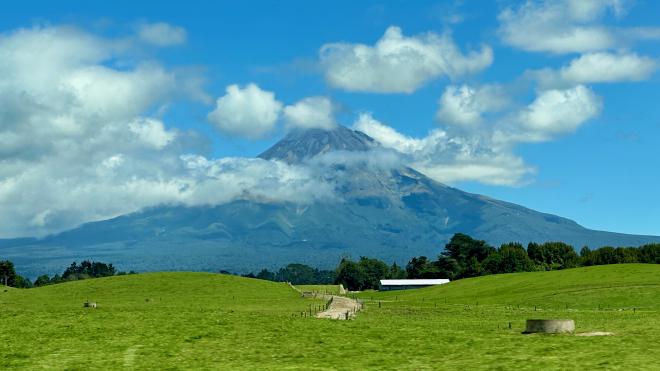
In the afternoon we took a drive to New Plymouth, on the west coast. The clouds around Mount Taranaki were starting to break up; this is a shot taken from the car.
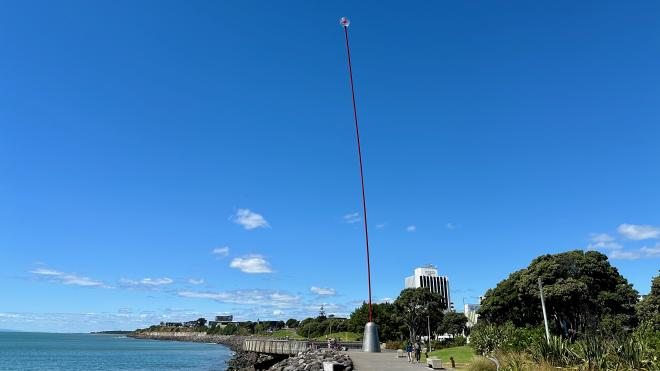
In New Plymouth, Bev dropped us and Stew off by shore, and we headed north from there along the New Plymouth Coastal Walkway. The long spikey thing with the ball is a kinetic sculpture that blows in the wind. The air was fairly calm during our visit and the ball was moving gently; apparently it whips around quite aggressively in high winds.
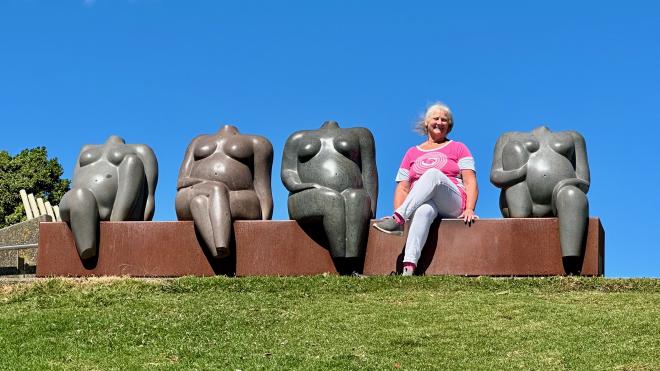
Farther along the sea wall we found this sculpture, with a Karen-sized gap just waiting to be filled. Greg suggested the picture would be better if Karen dressed the same as the other figures, but Karen disagreed.
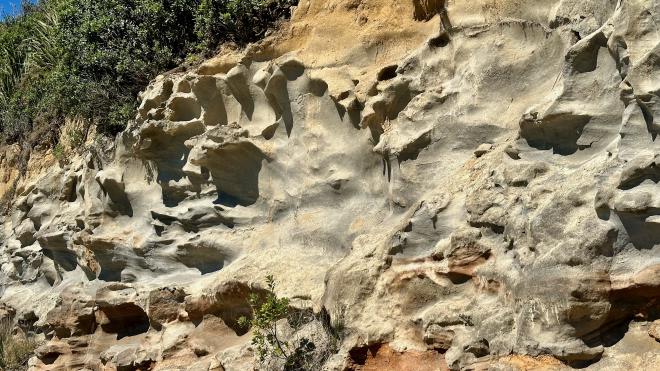
Some of the weathered rocks along the walk were very slick and organic-looking.
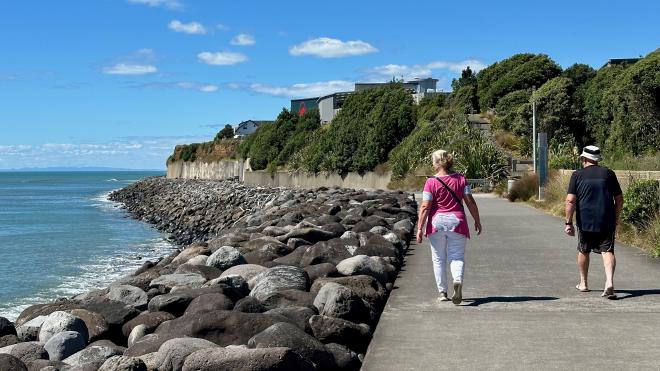
We continued walking a bit over four kilometres up the coast. Before he retired, Stew managed a concrete company in Stratford that supplied much of the material for the walkway.
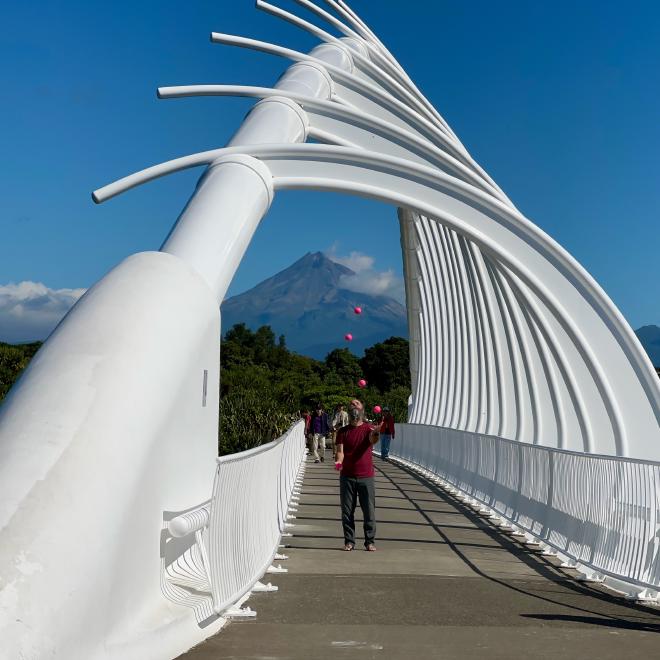
Bev met us at our destination, the Te Rewa Rewa Bridge, which has a very striking twisted design and was deliberately oriented to frame Mount Taranaki. It’s a popular spot for photos.
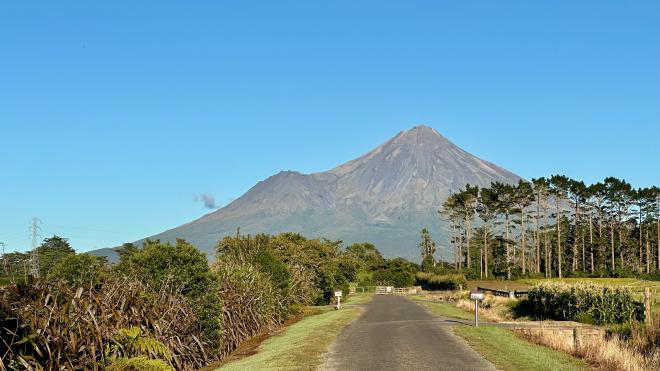
The next day dawned clear, and Greg went out for a run. Near his turn-around point he had this terrific view of an almost-cloudless Mount Taranaki.
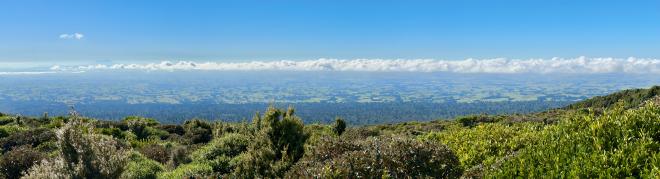
The weather in the region can change very quickly, so Bev and Stew decided to take advantage of the clear spell by heading up to the Stratford Plateau lookout, which is as high up the mountain as you can drive at 1172 metres. This was the view down, looking over the plains. The town of Stratford is slightly left of centre, well off in the distance.
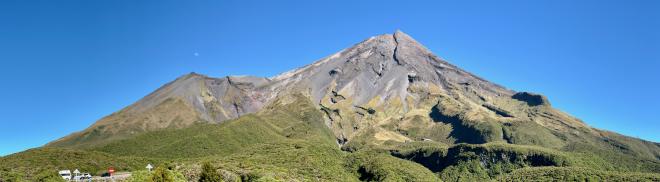
This is the view up from the lookout. Mount Taranaki’s peak is at 2518 metres. If you look slightly right of centre, near the top of the wooded area, you’ll see a building. This is a ski lodge, at the base of a chair lift. Getting there is quite an arduous hike. The park is building a new bridge across the ravine at the centre of the photo to make the ski hill more accessible.
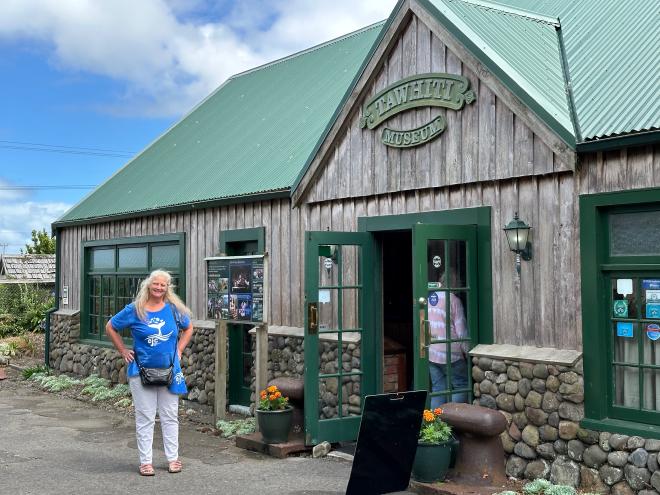
From there we headed south to the Tawhiti Museum. This is privately-run, with quite a diverse collection of artifacts and displays, focusing on the history of the Taranaki region.
The first part of the Museum that we visited (“Traders and Whalers”) described the horrific Musket Wars of the first half of the 19th century. When the first Europeans arrived, they traded the Māori muskets for bales of harakeke (New Zealand flax) fibres, which were much in demand to make rope. Māori tribes that acquired muskets had an overwhelming military advantage over tribes that didn’t, which disrupted and dramatically intensified inter-tribal warfare on the North Island. Generally, the northern-most tribes acquired muskets first, which left the southern tribes desperate to catch up. And of course the Europeans attempted to cheat everyone, passing off used and unreliable muskets left over from the Napoleonic Wars as desirable. Between 20,000 and 40,000 people died in the wars, and tens of thousands of Māori were enslaved.
This section of the Museum was set up almost like a theme park ride, starting with a walk through simulated caves, narrated by a live guide, and proceeding to a boat ride through a life-sized animatronic diorama including a battle with “gunfire”. The whole thing was a bit cheesy, though well-done and less cheesy than it sounds. The animatronic figures, designed by museum owner Nigel Ogle, who also did the Romeo and Juliet figures from the Glockenspiel, were beautifully-sculpted and almost lifelike. Unfortunately the Museum has a strict no-photography rule for this section, so we have no pictures to show you.
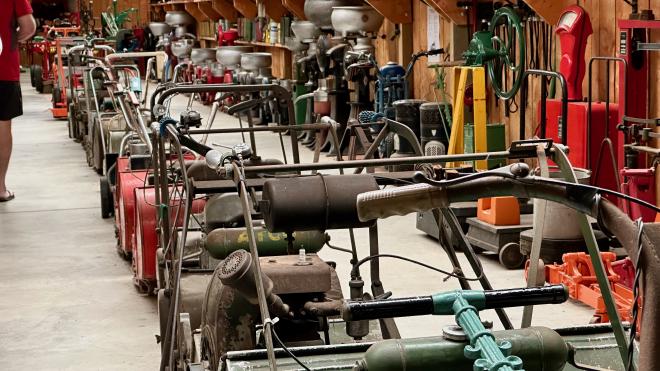
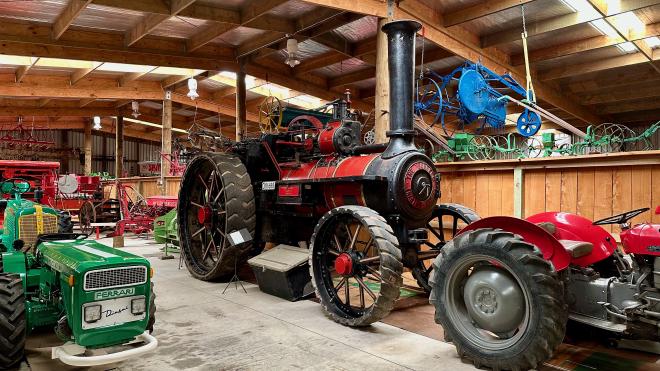
We next visited the exhibit of historic farm equipment from the region.
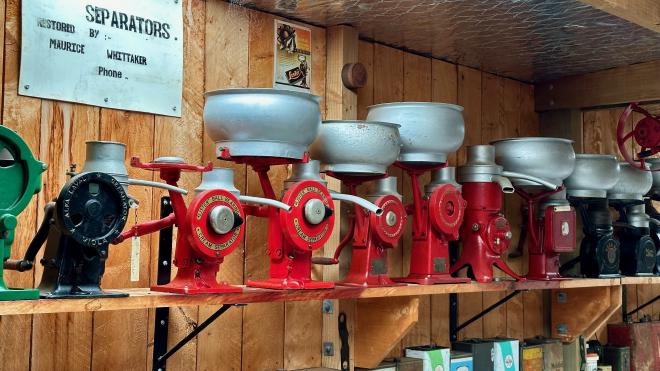
Much of the Taranaki region is given over to dairy cattle. These are cream separators.
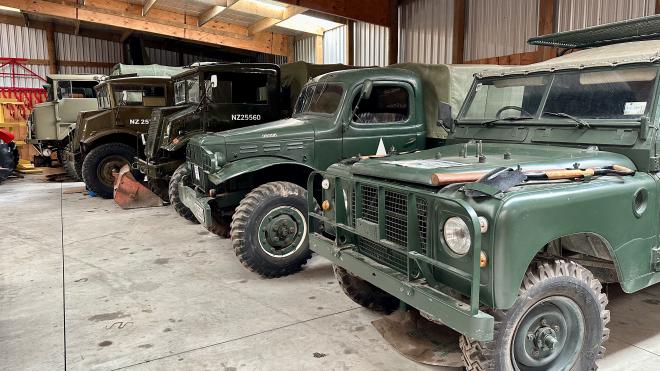
There was also a small collection of Army vehicles of various vintages…
… and a rather impressive collection of tractors. Earlier in his life Stew ran a beef cattle ranch, where he used some of the models of tractors currently on display.
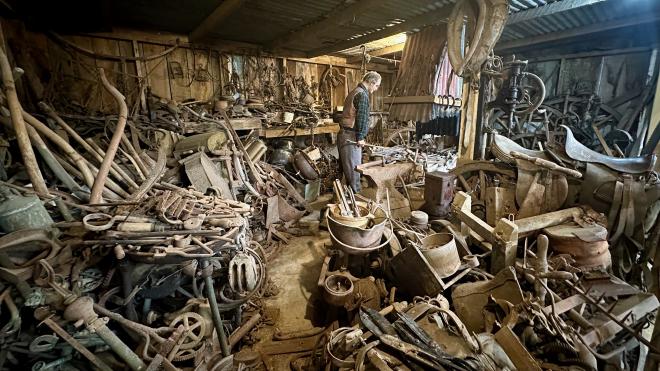
The Museum includes several life-sized dioramas depicting rural Taranaki life, including this incredibly-cluttered blacksmith shop. Our son Tristan is planning to set up as a blacksmith as soon as he has the space. We sent him this picture with a warning that if his shop ever got this messy we’d disown him.
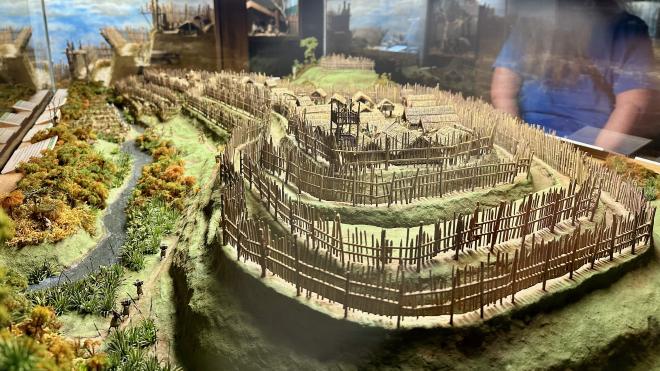
After a lunch at the Museum cafe, we continued into a section that focuses on the early history of the region. This miniature diorama depicts a Māori stockade village. Most Māori lived in open, unfortified villages, most of the time. Stockades like this were only used during periods of inter-tribal warfare.
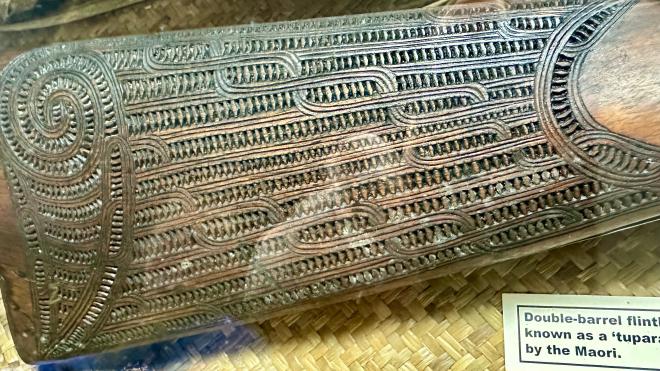
As mentioned, muskets were highly prized by the Māori, and often elaborately decorated, as you can see from this flintlock stock.
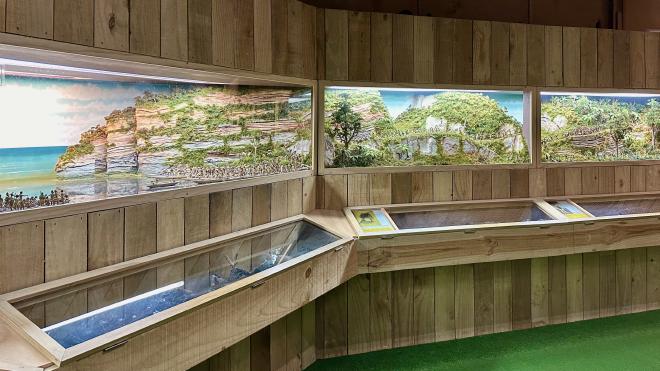
The Museum included many other miniature dioramas depicting historic events in the region.
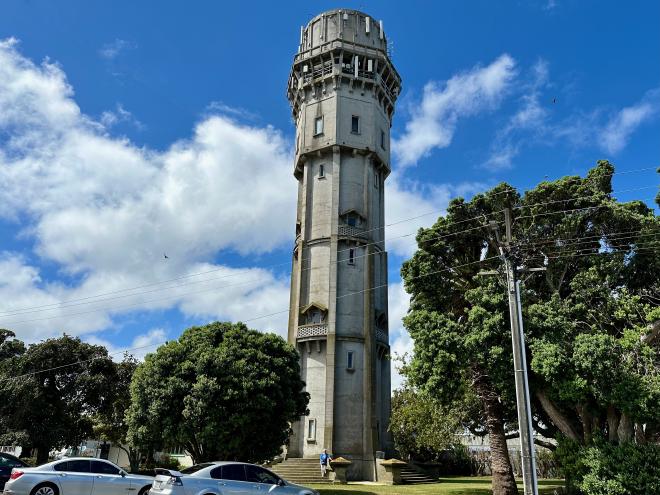
From the Museum we drove into the town of Hawera, where we stopped briefly at its fortress-like water tower. This was built in 1914 to improve water pressure and help with firefighting, at the insistence of insurance companies following a massive fire in 1912. Upgrades to the town’s water mains made it obsolete shortly after construction, but it remains as an imposing landmark. The tower is 51.2 metres tall; note Karen in the blue shirt, for scale.
On the drive back to Stratford, we saw that the mountain was clouding up again, so Bev and Stew’s decision to visit the lookout in the morning had been a wise one.
We were supposed to leave Stratford on the morning of 2 March. However, Greg spent the night quite ill with what we think was food poisoning – ’though we have no idea where he might have picked it up. Fortunately Bev and Stew were happy to host us for an extra day, and we were able to cancel our bus ride without penalty and re-book for the following day.
Greg was in pretty rough shape, and slept through until 4:30 pm, going back to bed a few hours later. Karen, Bev and Stew spent a mostly-quiet day around the house.
By the next morning Greg was feeling well enough to travel, so Bev and Stew dropped us off at the Stratford bus stop and after a few hugs we were on our way to Carterton.
We can’t thank Bev and Stew enough for their wonderful hospitality, and thanks also to Elizabeth for making the connection. Bev and Stew will be in North America in May, including a short visit with Colin and Elizabeth. Unfortunately we’ll be we’ll be too far away to join them – but we wish them a wonderful trip!